Halloween — Up To 60% Off



Updated October 22, 2026 · 9-minute read
A trading journal is a record of every trade you take: what you traded, why you took it, how you managed it, and what happened. Kept well, it turns a pile of wins and losses into evidence. You stop guessing which setups work and start knowing, because the numbers are in front of you.
Most traders who start a journal stop within a month. The usual reasons: they log too much, they never review it, or the logging takes longer than the trading. This guide fixes all three. It covers what to record (and what to skip), three example entries you can copy, a 30-minute weekly review, and an honest look at spreadsheet vs app.
If you want to skip the setup, a dedicated trading journal imports your trades and calculates the numbers for you. But the habits below matter more than the tool.
Why keep a trading journal at all
Your broker statement tells you what happened. A journal tells you why. Three things only a journal can show you:
- Which setups actually make money. You may feel your breakout trades are your best. Your journal may show they are break-even after fees, and your pullback entries carry the account.
- Where your rules break. Most losses that hurt are not bad trades; they are trades you should not have taken. Logging whether each trade followed your plan makes that visible.
- Your patterns in time. Many traders lose most of their money in a narrow window: the first 15 minutes, Friday afternoons, the trade after a big loss. You will not see that from memory.
What to log for every trade
Split your journal fields into three groups. Fill in the first group for every trade without exception. The second group takes a minute and is where most of the value is. The third is optional.
1. The facts (non-negotiable)
| Field | Example | Why it matters |
|---|---|---|
| Date and time of entry and exit | 2026-10-14, 09:42 → 10:15 | Finds your best and worst hours |
| Instrument | AAPL, ES Dec 26, EUR/USD, BTC | Finds where your edge is |
| Direction | Long / short | Many traders are much better on one side |
| Size | 200 shares, 2 contracts, 0.5 lots | Needed for risk and P&L |
| Entry and exit prices (every fill) | 227.40 in, 229.10 out | Scaling in and out changes the result |
| Stop and target at entry | Stop 226.60, target 229.80 | Lets you calculate R and judge exits |
| Fees and commissions | $2.10 | Small fees decide whether scalping works |
| Net P&L | +$337.90 | The outcome |
2. The context (where the learning is)
| Field | Example |
|---|---|
| Setup / strategy name | “Opening range breakout” |
| Reason for entry, one sentence | “Broke the 5-minute high on 2x average volume, market green” |
| Did it follow my plan? | Yes / No, and which rule broke |
| Risk in R | Risked $160 (1R); made $337.90 = +2.1R |
| Emotional state, one word | Calm, rushed, revenge, bored, FOMO |
| Market condition | Trending, choppy, news day |
| Mistake tag | Early exit, moved stop, chased entry, oversized |
| Screenshot | Chart at entry and at exit |
R is profit or loss divided by the amount you planned to risk. It lets you compare a $50 trade with a $500 trade, and it is the single most useful number in a journal.
3. Optional extras
- Time spent in the trade (holding period).
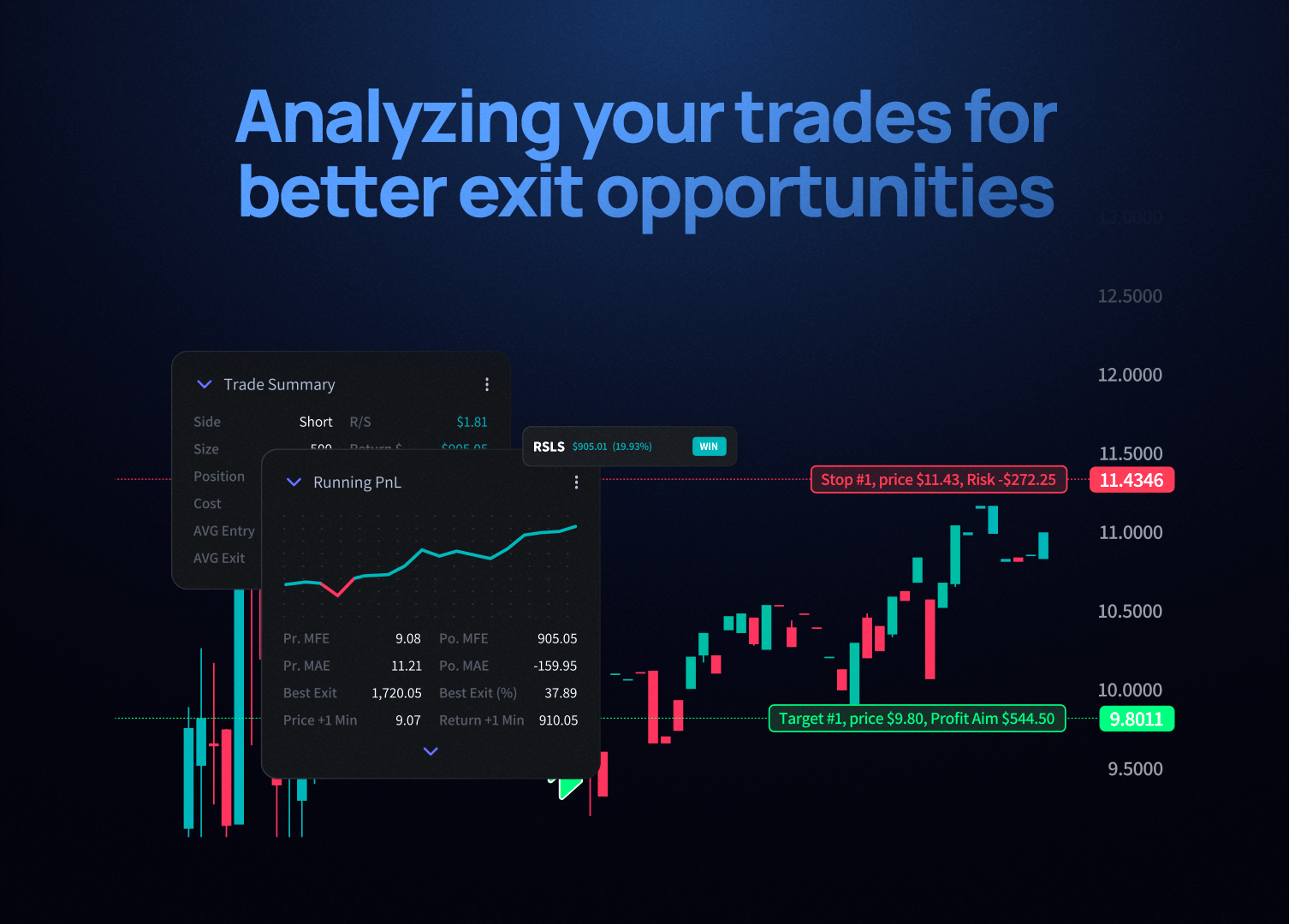
- Maximum favorable and adverse excursion (MFE/MAE): how far the trade went in your favor and against you before you exited. This tells you whether your stops are too tight or your targets too close. Apps calculate it from price data; in a spreadsheet you have to look it up by hand.
- Pre-market notes: your plan for the day before the open.
What to skip: long paragraphs. If you write more than three sentences per trade you will stop journaling. One sentence of reason, one word of emotion, one mistake tag.
Three example journal entries
Example 1: a winning trade that followed the plan
2026-10-14 · AAPL · Long · 200 sh
Entry 227.40 (09:42) · Exit 229.10 (10:15) · Stop 226.60 · Target 229.80
Fees $2.10 · Net +$337.90 · Risk $160 → +2.1R
Setup: opening range breakout. Reason: broke the 5-min high on 2x volume, SPY green.
Plan followed: yes. Emotion: calm. Mistake: early exit (target was 229.80; sold at 229.10 when it stalled).
Lesson: price reached 229.85 at 10:40. My early exit cost 0.9R. Track how often that happens.
Example 2: a losing trade that followed the plan
2026-10-15 · ES Dec 26 · Short · 1 contract
Entry 6,012.25 · Exit 6,016.25 (stopped) · Fees $4.50 · Net −$204.50 · −1.0R
Setup: failed breakout short. Reason: rejected yesterday’s high twice.
Plan followed: yes. Emotion: calm. Mistake: none.
Lesson: a good loss. The setup was valid and the stop did its job.
Example 2 matters as much as Example 1. A loss that followed the plan is not a mistake. Tagging it that way stops you from abandoning a working strategy after a normal losing streak.
Example 3: a losing trade that broke the plan
2026-10-15 · TSLA · Long · 100 sh
Entry 251.80 · Exit 247.30 · Fees $1.40 · Net −$451.40 · Planned risk $150 → −3.0R
Setup: none. Reason: “it was moving and I missed the first move.”
Plan followed: no: no setup, no stop placed, entered 10 minutes after Example 2’s loss.
Emotion: revenge. Mistake: chased entry, no stop.
Lesson: this trade cost 3x my planned risk. Rule to add: no new trade for 15 minutes after a loss.
Three entries, under two minutes each. That is the whole daily habit.
The weekly review: a 30-minute routine
Logging without reviewing is just bookkeeping. Block 30 minutes at the same time every week (Saturday morning or Sunday evening works for most people) and go through these six steps in order.
1. Totals (5 minutes). Net P&L, number of trades, win rate, average win, average loss, and total R. Write them on one line so you can compare week to week.
2. By setup (5 minutes). Group trades by setup name. Which setups made money in R? Which lost? With fewer than 20 trades in a setup, treat the numbers as a hint, not a verdict.
3. Plan vs no plan (5 minutes). Add up P&L for trades that followed your plan and trades that broke it. For most traders this is the most uncomfortable number in the journal, and the most useful. If your rule-breaking trades lost $900 this week and your plan trades made $600, you do not have a strategy problem.
4. Mistakes (5 minutes). Count your mistake tags. Pick the most frequent or most expensive one. That is your one focus for next week. Only one.
5. Time and day (5 minutes). Sort by entry time. Are your losses clustered in one window? If yes, write a rule: “No trades after 11:30” is a perfectly good rule.
6. Write three lines (5 minutes).
- What worked this week.
- The one mistake I will fix next week, and the rule that fixes it.
- One thing I will do more of.
Once a month, look back at four weeks of those three-line notes. Patterns you could not see in a single week become obvious.
A monthly check of your numbers: profit factor (gross profit divided by gross loss; above 1.0 means you made money), average R per trade, and your largest losing day compared with your average winning day. If one bad day erases a week, your risk rules are the place to work, not your entries.
Spreadsheet vs app: which should you use?
Both work. The right choice depends on how often you trade and how much time you will spend on data entry.
A spreadsheet is enough if
- You take fewer than about 20 trades a month.
- You swing trade or invest, with simple single-fill entries and exits.
- You like building your own formulas and charts.
- You want zero cost and full control.
Downsides: every fill is typed by hand, and partial fills and scaling make that slow and error-prone. Fees, R, MFE/MAE and options spreads are hard to calculate. Charts of your trades need screenshots. And the more you trade, the more likely you skip a day, and a journal with gaps lies to you.
If that is you, start with our free trading journal template for Excel and Google Sheets. It has the fields from this guide already set up.
An app is better if
- You day trade or take more than a few trades a week.
- You scale in and out, trade options spreads, or trade futures with commissions that matter.
- You want reports by setup, time of day, day of week and holding period without building them.
- You trade from more than one account or broker.
A journal app imports your fills from your broker, calculates P&L and fees, shows R once you have set a stop, plots each trade on a chart, and builds the setup, time and mistake reports in the weekly review above (on TraderSync, reports are part of the paid plans). TraderSync, for example, works with 700+ integrations.
Cost does not have to decide it. TraderSync has a free trading journal plan with no credit card and no expiry: unlimited manual trade entry, 30 file-imported executions per month, and P&L charts with an overview dashboard. That is enough for many swing traders, and a way to test whether an app suits you before paying for anything.
A practical path
- Start with the template for two weeks. Learn which fields you actually fill in.
- If typing fills takes more than five minutes a day, move to an app and import instead.
- Keep the habits: one sentence of reason, one emotion word, one mistake tag, and the weekly review.
Common mistakes when keeping a trading journal
- Logging only losers (or only winners). You need both to see what separates them.
- Writing essays. Short entries get written; long ones get skipped.
- Never reviewing. If you do not have a review time in your calendar, you do not have a journal.
- Changing five things at once. Fix one mistake per week, then check whether it helped.
- Judging a setup on five trades. Small samples mislead. Keep collecting before you drop or double down on a strategy.
- Ignoring fees. They are invisible per trade and large per month, especially for active traders.
Frequently asked questions
What should I write in a trading journal?
For every trade: date and time, instrument, direction, size, entry and exit prices, stop and target, fees, and net profit or loss. Then add the setup name, a one-sentence reason for entry, whether the trade followed your plan, your risk in R, one word for your emotional state, and a mistake tag if there was one.
How often should I review my trading journal?
Log each trade the same day and review weekly. A 30-minute weekly review is enough: totals, results by setup, plan vs no-plan trades, your most common mistake, results by time of day, and three written lines for next week. Do a longer review once a month.
Is a spreadsheet good enough for a trading journal?
Yes, if you trade fewer than about 20 times a month with simple entries and exits. If you day trade, scale in and out, or trade options spreads, an app that imports trades from your broker saves time and avoids calculation errors.
What is R in a trading journal?
R is your profit or loss divided by the amount you planned to risk on the trade. If you risked $100 and made $250, the trade was +2.5R. It lets you compare trades of different sizes fairly.
Is there a free trading journal app?
Yes. TraderSync has a free Basic plan with no credit card and no expiry. It includes unlimited manual trade entry, 30 file-imported executions per calendar month, P&L charts and an overview dashboard.
How long should I keep a trading journal before judging my strategy?
Collect at least 20 to 30 trades of a setup before drawing conclusions about it, and review the full journal monthly. Small samples can make a good strategy look bad, or a bad one look good.